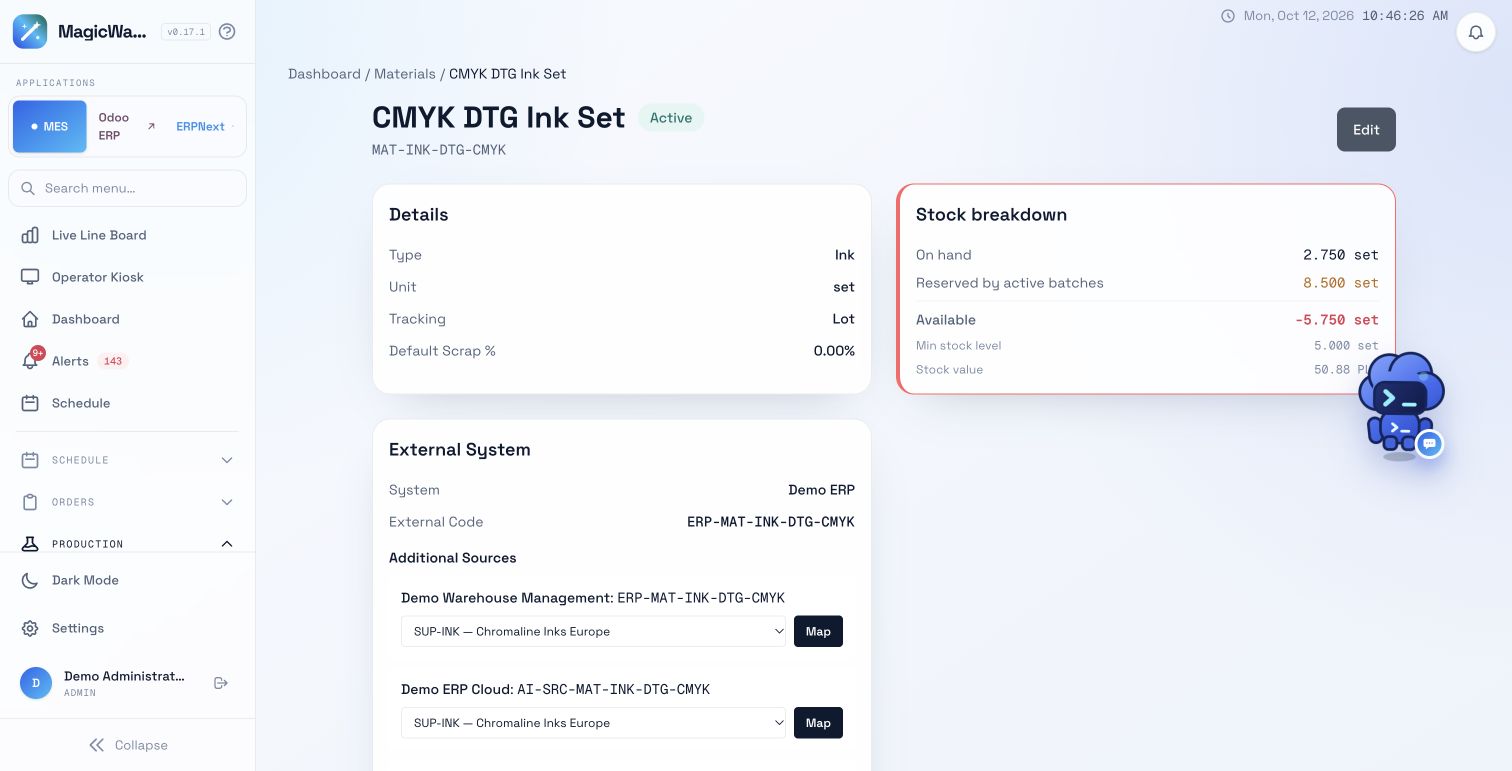
Check material readiness before production starts.
See on-hand stock, existing reservations and the available balance beside production requirements. Follow a recorded shortage into the lines and work orders it may affect.
Email the founders · tell us your production challenge
Actual MagicWand product screen · demo data · click to enlarge
01 / MATERIAL READINESS
See availability after reservations
Material records distinguish on-hand quantity from stock reserved by active batches and the available balance. This helps the team review whether recorded stock is already committed. Keep the production requirement, its reservation and the material record in the same conversation.
In the demo
Review the on-hand, reserved and available quantities. Follow the work-order and bill-of-materials context when assessing readiness.
02 / MATERIAL READINESS
Inspect the lot and requirement context
Material records include tracking details, lots, expiry dates and status. Bills of materials connect a material to process templates and product requirements. Stock movements and external-system references give stores and production teams more context for reviewing the recorded position.
In the demo
Check the relevant lot status and expiry, then review BOM requirements and stock movements. Confirm the records appropriate to the production decision.
03 / MATERIAL READINESS
Follow shared demand into the factory
The Factory Constraint Map shows materials shared across production lines and the exposure associated with those dependencies. Recovery options add estimated impact, risk and approver requirements. A proposed material response needs review against the competing demand and current records.
In the demo
Trace the shortage to the affected lines. Review shared stock and priority allocation before deciding which response to approve.
FOLLOW THE OPERATING QUESTION
What we’ll walk through.
01
Start with the requirement
Inspect the work-order and bill-of-materials context for the planned work.
02
Check the available balance
Review on-hand stock together with recorded reservations and the available quantity.
03
Inspect lots and shared demand
Check the relevant status and expiry, then follow shared-material dependencies across lines.
04
Review the response
Inspect competing demand, risk and prerequisites before approving a proposed material response.
BRING AN EXAMPLE TO YOUR DEMO
Start with the process you use today.
We’ll review your current process, demonstrate the relevant product views and discuss data and connection requirements. You can describe the records you use; sample data is optional.
These are discussion inputs, not a complete integration specification or a fixed implementation promise.
Example work order and BOM
The product requirement, material codes, quantities and units your team uses.
Stock and reservation records
On-hand quantities, existing commitments and the balance available for the work.
Relevant lots
Lot status, expiry and the records used to determine whether the stock is usable.
Current data sources
Stock movements and any warehouse or ERP references that need assessment.
BUYER QUESTIONS
Before your product demo.
Is material readiness the same as total inventory?
Readiness concerns the material available for planned work. On-hand stock, existing reservations, lot status and production requirements each add context to that decision.
Does the material workflow place purchase orders automatically?
This workflow focuses on recorded material availability, production constraints and responses for review. Discuss your procurement process and integration requirements during the walkthrough.
Can we connect ERP or warehouse data?
Enterprise connectivity interfaces and external-system references are part of the product. Connector setup, source freshness, mapping and suitability need assessment for your environment.
Why can available material differ from on-hand stock?
Stock recorded as reserved by active batches is already committed. Review the reservation and material records, as well as the relevant lot status, when assessing readiness for another order.
What should we bring to a material-readiness demo?
An example work order, its BOM, and the stock and reservation records used today. Describe who updates those records and which warehouse or ERP systems hold them.
Is this a complete inventory or procurement system?
The workflow described here concerns recorded availability, production readiness and material constraints. Assess your wider inventory, purchasing and transaction requirements separately during the walkthrough.
Tell us how you compare requirements, available stock and reservations today. We’ll show the material and factory-constraint views, then discuss your source records and connection needs.